Peter Eckel describes John Fry's previous track record of establishing long-term plans and goals for institutions, and expects that he will do the same for Temple. He also emphasizes Temple's importance in the region and its' need for a competent leader.
A study by Michael A. Gottfried finds that early elementary school teachers report feeling less close to chronically absent students and view them less positively, even when those students don’t cause trouble in the classroom.
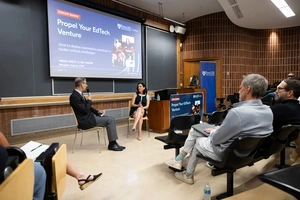
“Propel Your EdTech Venture” brought together researchers, entrepreneurs, U.S. Department of Education officials, and corporate leaders to learn strategies, drive sustainable growth, and put research into practice.
Associate Professor Brooks Bowden explained the benefits of better school quality and fairness, including long-term economic gains for the state, would greatly outweigh the hefty cost.
About 150 students, alumni, faculty, staff, and industry leaders are expected to gather at Penn GSE on Saturday, June 22, to celebrate the anniversary.
Julie Wollman says that most institutions of higher education tend to think they’re the only institution that’s not going to be affected by enrollment problems.
The Constance Clayton Professor of Urban Education and executive director of REC weighed in on a University of Georgia study revealing how discriminatory experiences could harm children’s development.
Penn GSE’s annual Alumni Weekend event featured a faculty panel discussion on “The Price of Education” and celebrated the winners of the Education Alumni Awards.
Karen Weaver says that any plan to de-professionalize college athletics could be a hard sell if it looks like it’s emphasizing something other than winning.
The Math Tutoring in an Elementary School course, supported by the Netter Center, is open to Penn undergraduate and graduate students and aims to redefine traditional math tutoring.
Robert Zemsky says that the richest and biggest institutions of higher education will continue to prosper while small and vulnerable schools go out of business.
In this enlightening episode of the Practitioner Scholar, Lisa-Marie Aird welcomes Dr. Raj Ramachandran, a trailblazer in leadership consulting and an alum of the Penn CLO program's first cohort, who shares his personal journey from being legally blind to becoming a renowned consultant, igniting a passion for creating tangible societal impacts.
Brooks Bowden recommends school districts prioritize spending projects with long-term benefits, including facilities, data analytics, student support, and professional development.
Ravitch's presentation, which took place on May 10, showcased her extensive experience and projects that span across diverse cultural contexts, emphasizing the transformative potential of participatory action research in fostering youth leadership and agency.
Penelope Lusk, a Ph.D. candidate at Penn GSE, has been awarded a 2024 Queen Elizabeth Scholarship for a year of study at the University of Oxford in England.
Ed Brockenbrough told Philadelphia's Board of Education the district must provide teachers with professional development on how to address conflicts like the war in Gaza in their classrooms.
The initiative provides University funding up to $100,000 for Penn teams piloting practical projects that address social justice issues in Philadelphia.
Katharine O. Strunk, dean of the Penn GSE, joins her fellow deans from prominent Pennsylvania institutions in highlighting the state's teacher shortage crisis.
Damani White-Lewis discusses the diminished likelihood for women and POC to get counteroffers compared to their white male counterparts, and emphasizes the importance of counteroffers as an underutilized faculty diversity strategy.
The Graduate School of Education helps students put their knowledge into practice through community engagement. Three soon-to-be graduates speak with Penn Today about how their service enabled them to deepen their connection with West Philadelphia.
As more students plug queries into ChatGPT and other artificial intelligence (AI) tools, it’s time for more faculty and schools to catch up and offer a roadmap on fair and ethical usage.
Hosted by Melissa Monti, Dr. Ann Schulte discusses the integration of AI in talent development and the importance of an always Beta mindset for continuous workplace innovation.
Jonathan Zimmerman argues that Congress should not pass a law that uses the IHRA's definition of antisemitism, because it would prevent debate and discussion about what constitutes antisemitism on college campuses.
“If money’s taken away because kids are absent, it’s leaving less money to tackle the problems in a more restorative, preventative, and less reactive approach,” says Ericka Weathers.
Barbara Kurshan emphasizes the importance of women having mentors in their field, especially to combat imposter syndrome and to feel supported in their careers.
Weaver explores the closures of 13 NCAA Division III colleges, linking them to demographic shifts and their severe impact on athletics, while emphasizing the need for sustainable financial strategies.