Sydney Freeman Jr., a visiting scholar, and Laura W. Perna write that faculty of color and women faculty are known to shoulder more of the invisible labor associated with the college teaching profession.
While many former athletes, business majors and even some sports fans aspire to work in college sports, it doesn’t take long to realize that it cannot be defined as a typical 40 hour a week job, says Karen Weaver.
A pivotal moment in Penn GSE’s history, the groundbreaking ceremony for the School’s dramatic building expansion marked the start of a project that will fulfill a vision of 'One Penn GSE.'
At a time of incredible flux, Penn GSE’s innovative leadership programs are helping create better school environments, amplifying the impact of K-12 leaders, shaping the future of higher education, and producing scholar-practitioners for the workplace.
Responding to the emerging needs of educators and leaders, Penn GSE’s Center for Professional Learning cultivates learning and connections that endure.
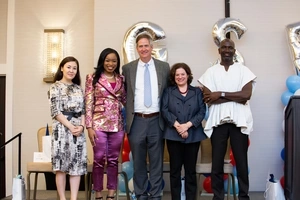
A powerful, lively, and heartfelt panel took over the second floor of Houston Hall this past week as part of the seventh annual Women of Color in Higher Education Summit
Should there be more than two podiums, two gendered sets of record books? More could be done to recognize transgender athletes’ accomplishments, Ross Aikins writes.
What can institutions do to help students make informed choices about higher education? How can we make sense of skepticism surrounding cost, value, and return on investment? Four members of the Penn GSE community at the forefront of these changes spoke at a recent Penn Alumni panel event.
The Penn GSE Magazine takes a look at the three master's programs in teacher education at Penn GSE — and the stories of three of its students, each on their own journey.
Laura Perna speaks about net price calculators and their implications in college admissions. The three buckets that matter for college opportunity are financial aid, academic readiness, and information, she says. Net price calculators are an “important mechanism to help people understand really early on in the process ideally, how much it will actually cost.”
Jonathan Zimmerman opined that the role of an educational institution is to make its students more aware, informed and thoughtful adults through structured dialogue – not necessarily to discipline them for words spoken and actions taken in the past.
One of many virtual offerings of Penn GSE’s Center for Professional Learning, the Strategic Leadership Certificate program is helping educators strengthen their effectiveness and deepen their impact.
Amalia Daché spoke about the mistreatment of protesters in Cuba. “Cuba is a political apartheid. There is definitely racial discrimination happening in Cuba,” she said. “When Cuba gets a cold, Afro-Cubans get the flu, and they die.”
The NCAA is hosting a Constitutional Convention to consider “sweeping” changes to how it governs college athletics. What's at stake? What does it mean for the future of college athletics?
Laura Perna said that applying for financial aid can be complicated for students. However, the Alamo Promise program, which provides students in Texas with free tuition and additional services, sends “a clear message with no fine print,” she said.
While migration research tends to focus on migrants and the countries that receive them, Briana Nichols, a joint doctoral candidate in Education, Culture, and Society, and Anthropology, chose to focus her research on the community members who are fighting to stay.
Laura Perna discussed how the challenges of constructing debt-free degree programs may be daunting for colleges, but the ends justify the means: The programs create a more socioeconomically diverse student body, to the benefit of everyone.
Laura Perna spoke about how so-called College Promise Programs that reduce the costs of attending college may encourage more students to enroll — but cautioned a number may still be deterred by fears of hidden costs.
Penn GSE’s Robert Zemsky, an expert on higher education, is leading a new project called “College in 3” to explore the feasibility of creating intentional three-year degree programs.
2009 McGraw Prize winner, Sarita E. Brown, co-founded Excelencia in Education in 2004 to accelerate Latino student success in higher education by identifying, analyzing and disseminating information on effective higher education practices that highlight problems and solutions facing Latino students.
The Penn GSE community mourns the loss of longtime staff member Betty Deane, who served an extraordinary tenure of more than five decades at the School.
Penn GSE alumni in educational leadership roles are at the forefront of organizations’ efforts towards advocacy, overcoming barriers, creating paths to success, celebrating differences, and more.
Laura Perna spoke about efforts to make community college tuition-free. "There's power in the message that tuition is free. Figuring out how much college costs is complicated," she said.
2013 McGraw Prize winner, Deborah Bial is the President and Founder of the nonprofit The Posse Foundation which uses its signature Posse model to support young scholars with diverse demographic backgrounds through attending, enrolling and completing college and emerging as strong leaders from diverse backgrounds who are able to develop consensus solutions to complex social problems.
Amalia Daché criticizes people who have blamed the U.S. embargo and not the Cuban government for the crisis in Cuba. “She was shocked to see how the U.S. media and Twitter were taking Afro-Cubans out of the narrative and blaming the U.S. and the CIA for the demonstrations,” she said.
Laura Perna spoke about accommodating the needs of adult students. “There is a complexity to adult learners,” she said. “It is really recognizing, ‘What are the circumstances of individual people’s lives?’ If someone is to enroll in college, how do you make it possible for them to attend?”
Penn GSE’s Amalia Daché has studied Afro Cuban life and educational opportunities under Cuba’s dictatorship. She says the world is seeing Afro Cubans’ frustration with the racist and classist society the regime maintains.
Seeing hope amidst current challenges, Penn GSE professors, scholars, and graduates are examining the changing landscape of higher education and envisioning opportunities to advance educational opportunity and racial justice.
Three distinguished Penn GSE alumni shared their perspectives on finding strength in the face of adversity, supporting mental health, and rallying to improve social justice.
Amalia Daché spoke about the importance of diverse educators. “Although I was successful at navigating higher education, not seeing or identifying with teachers always made me feel like I was an outlier,” she said.
Penn GSE’s Karen Weaver argues that legislation pending in Congress points to the need for college athletes’ voices to be a bigger part of the conversation.
Perna: “We have seen so many proposals for free college and debt relief in the past year, even amidst a pandemic, because the painfully high cost of a degree is stifling another generation of young people and continuing to shut out minority and low-income Americans."
This spring, Garrett became Assistant Dean for Student Affairs in Yale’s Office of Gender & Campus Culture and the Alcohol and Other Drugs Harm Reduction Initiative.
Marcus Wright, a doctoral student in higher education, found that when colleges had to talk about COVID-19, they rarely prioritized first-generation students.