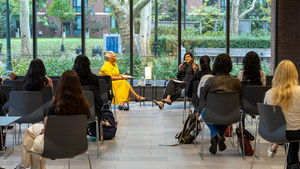
For Neerja Birla, improving mental health care means transforming the communities where people live, learn, and work.
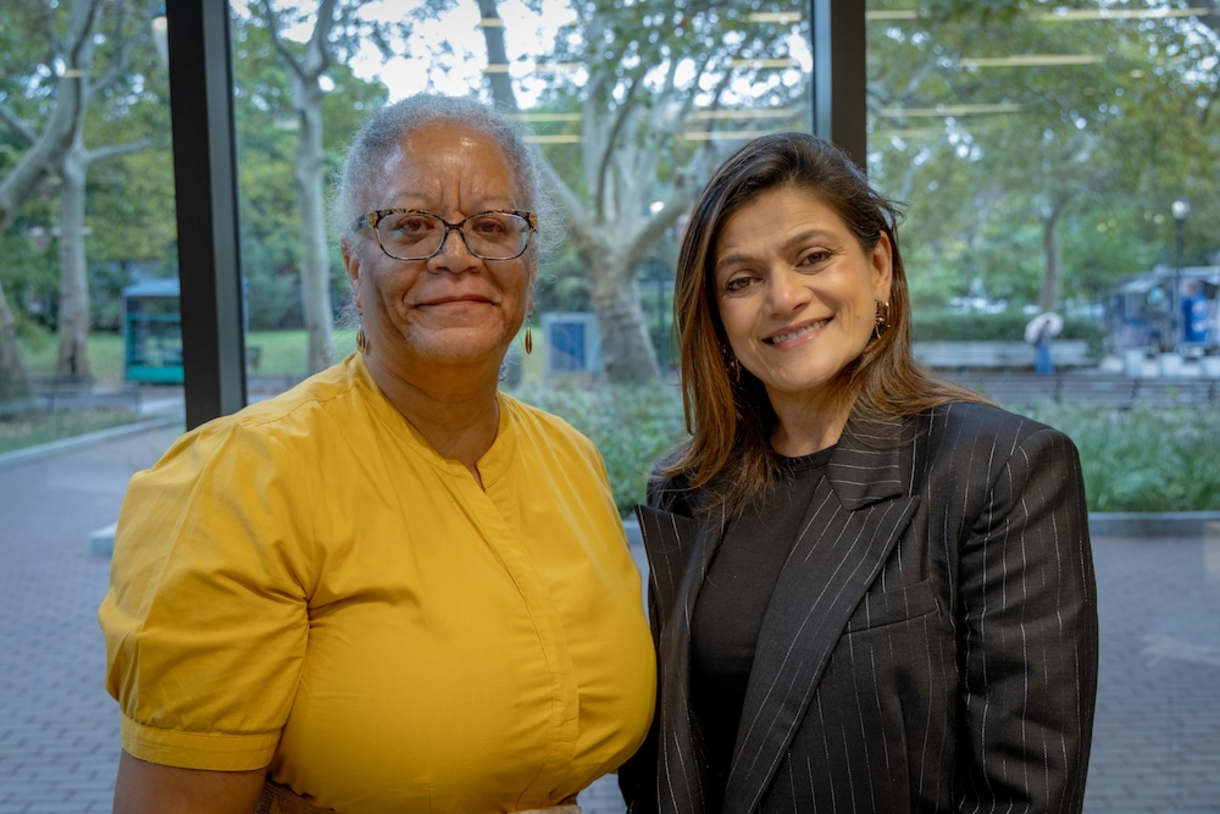
During her recent Penn GSE-hosted fireside conversation at Gutmann College House, Birla, founder and chairperson of Mpower, described her efforts to build a mental health ecosystem in India that encompasses awareness, counseling, therapy, and community outreach. In a conversation with Marsha Richardson, director of Penn GSE’s School and Mental Health Counseling Program, she argued that schools have an especially important role to play in identifying needs early and building a culture in which seeking help is normalized.
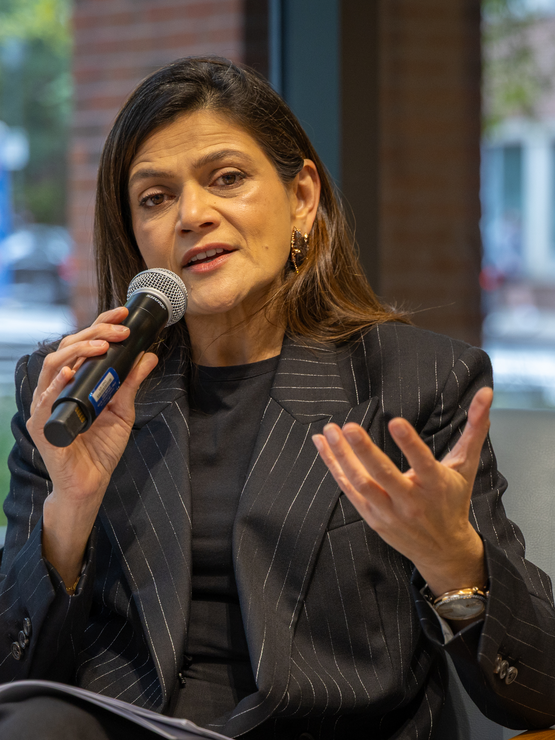
“A child is just spending an hour with a counselor in a week but is spending so much more time with their teachers,” said Birla, whose presence at Penn followed a full day that included attending the United Nation’s General Assembly meeting. “Therefore, it became imperative to actually train the teachers as first-aiders. And now it's mandatory for all teachers [at the institutions we run] to go through mental health first-aider training. They become the first responders.”
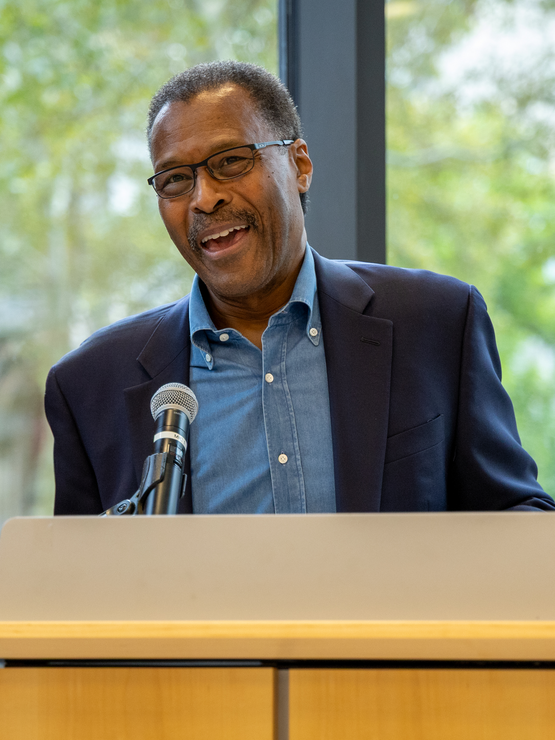
The event, “Schools as the Frontline of Mental Health,” was sponsored by the McGraw Center for Educational Leadership. John Silvanus Wilson, Jr. , executive director of the Center, opened the event by drawing on his own experiences responding to student mental health challenges at previous institutions, including as president of Morehouse College, and emphasizing the need for a “systems approach to mental health.”
That is exactly how Mpower works, Birla explained. They offer a comprehensive range of services including awareness initiatives, clinical services, workshops, research and curriculum building, trainings, and institutional outreach. That outreach has included trainings for police and the Indian equivalent of airport security as well as on college campuses—a “high-risk area,” said Birla. This vast network of services means that, according to Mpower’s website, it has touched more than 259 million lives.
Birla’s commitment to this work grew, in part, from personal experience. After the first of her three children was born, she struggled with post-partum depression, which she said she didn’t even have the language to express. And later, when someone close to her experienced a mental health condition, Birla struggled as a caregiver to understand what was happening and where to turn for help. That experience helped inspire Mpower, which she launched, she said, amid significant stigma around mental health in India.
“I think the first way to break the barriers was only conversation to just break stigma, to get people to talk, to get people to understand,” Birla said.
But stigma is only one obstacle. Birla described significant challenges making mental health care accessible across India’s vast and diverse population, particularly in rural communities. Language can, itself, she said, be a barrier to recognizing and communicating mental health needs.
“A lot of the lot of the Indian languages do not have a word for some of the mental health concerns,” Birla said. “For example, there is no word for 'anxiety' in Hindi. There is no word for 'depression.' So how do you explain it?”
The answer, she said, is helping people describe what they are physically experiencing rather than relying on clinical labels, while offering counseling in multiple languages and expanding online and community-based services. She also stressed that approaches must be adapted to particular populations, as “one model of care can never work.”
Schools are particularly important in that effort because young people spend so much of their lives there. Birla said her organization learned that counseling a child without addressing the larger environment was insufficient.
“We're not expecting teachers to be therapists, but we do want them to be first responders because the counselor can't be present in every every classroom,” Birla said.
Ultimately, Birla hopes to move mental health care upstream, from responding to crises to preventing them.
“We can keep fighting the fire, but we have to we have to look at how do we nip it in the bud,” she said. “I do believe that starting out young in schools . . . if we're able to get them young, if we're able to teach them the right coping mechanisms, if we're able to get them the right sensitization . . . [then] help-seeking behavior improves.”
Media Inquiries
Penn GSE Communications is here to help reporters connect with the education experts they need.


