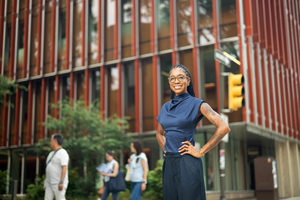
The founder and chairperson of Mpower, a leading mental health provider in India, had an intimate conversation with Marsha Richardson, director of Penn GSE’s School and Mental Health Counseling program, about her work and her professional journey.
As school systems navigate difficult decisions about everything from curriculum and tutoring programs to AI-powered learning tools, a new national effort aims to help education leaders make more informed choices about what works, for whom, and under what conditions.
Darin Brawley, Shai Reshef, and Michael Webber are recognized for their pioneering contributions that have advanced learning opportunities and impacted countless lives.
Seven finalists pitched their ventures live at the University of Pennsylvania, marking the first time the competition has returned to campus since the COVID-19 pandemic.
School and Mental Health Counseling student Madison McTier helps young students in local public schools improve social skills, emotional regulation, and self-advocacy through her role on the Netter Center for Community Partnerships’ school-based mental health and supportive services team.
The assistant professor's research explores how to make evidence-based mental health care more effective and more accessible for children, adolescents, and families—and why early support can change lives.
Penn GSE Associate Professor Justin Parent investigates how parenting, sleep, and childhood adversity become biologically embedded, with the goal of identifying opportunities to intervene early and help children thrive.
Language, Globalization, and Intercultural Studies master's students spent the summer expanding their practice and learning from and with people and communities across Philadelphia.
Associate Professor Wendy Chan is the lead statistician on a project testing school-based programs to help students who have difficulty with organization, time management, and planning.
Seven finalists will compete at the live pitch event on Monday, September 14, at the University of Pennsylvania, marking the first year the competition finals and Catalyst Innovation Summit join together.
The Learning Analytics and Artificial Intelligence master’s student presented her research on AI-powered learning in South Korea as one of just nine accepted submissions for the conference’s Practitioners, Industry, and Policy track.
Penn GSE and the School District of Philadelphia are co-creating solutions—in areas from algebra to AI—by listening first, aligning priorities, and turning research into real-time change across an urban school system.
In making the announcement, Vice Dean of Executive Programs Laurie Hall praised Richard’s leadership, expertise, and commitment to the program as interim director over the past year and as associate director before that.
Facilitated by Catalyst @ Penn GSE and funded by Remake Learning, the initiative will convene superintendents, Intermediate Unit and district executive leadership teams for a one-year research–practice partnership learning ecosystem integrating systems thinking, adaptive leadership, and neuroscience-informed leadership strategies.
Penn GSE's Gerald Campano and Teachers College’s Maria Paula Ghiso share the Diane Lapp–James Flood Award, a national honor from the International Literacy Association recognizing an outstanding and long-standing scholarly collaboration that has significantly shaped the field of literacy education.
Recent scholarship from Penn GSE faculty explores workforce development, STEM learning, executive function, racial literacy, language education, and collaborative learning.
Students, alums, mentors, and judges gathered at Penn GSE to celebrate a year of venture development, culminating in a showcase of innovative education solutions and a live pitch competition.
Penn GSE has been awarded a $720,000 grant by the William Penn Foundation to pilot a groundbreaking teacher-learning initiative designed to strengthen early grade instruction, improve teacher retention, and expand pathways for aspiring educators across Philadelphia.
A new report from Penn GSE researchers explores one of the most pressing tensions in education policy today: how to ensure rigorous preparation for teachers while expanding access to the profession.
A teach-in, organized by a coalition of Penn departments and centers , brought students, scholars, and community members together to examine how the events of September 11 continue to shape policy, identity, education, and public life 25 years later.
Penn GSE alumni, faculty, and education leaders returned to campus for a timely conversation on how artificial intelligence is reshaping classrooms, teaching, and learning.
Penn GSE’s Lori and Michael Milken President’s Distinguished Professor of Learning Sciences was recognized by the Association for Computing Machinery for transforming computer science education.
The recent graduate of Penn GSE’s Professional Counseling program is starting a job as a social worker at the Pediatric Anxiety Treatment Center at Hall-Mercer.
Starting this fall, the recent Urban Teaching Apprenticeship Program graduate will be teaching ninth- and tenth-grade English at West Philadelphia High School.
A recent panel discussion—kicking-off a series of events in honor of America's 250th birthday—covered the future of higher ed through the lens of its past and tumultuous present. The panel featured university leaders including Dean Katharine Strunk, McGraw Center for Educational Leadership Executive Director John Silvanus Wilson, Jr., and Penn President J. Larry Jameson.
The 670 graduates received one final lesson on their role preparing democratic citizens—and restoring public trust in education—from Dean Strunk and speaker Denise Forte.
After earning her Teaching, Learning, and Teacher Education Ph.D. at Penn GSE this spring, she will become an assistant professor in the Elementary Education program at Towson University in the fall.
The soon-be-graduate of the Mid-Career Doctoral Program in Educational and Organizational Leadership is the executive director of My Brother’s Keeper Newark and was recently elected to his local school board.
The soon-be-graduate of Penn GSE’s Professional Counseling program is headed to Washington, D.C., for a job as a Congressional Fellow with the Asian Pacific American Institute for Congressional Studies.
The student-led, human-centered gathering brought together scholars, industry leaders, and emerging researchers to explore the future of teaching and learning in the age of artificial intelligence.
Lauren Overton, GED'16, GRD'24, is among this year’s Lindback Distinguished Principals, while four Penn GSE alums and three partner-school educators receive the Lindback Distinguished Teaching Awards.
The William T. Carter Professor Emerita of Child Development and Education’s recent retirement was commemorated with a daylong symposium on “Imagining and Securing the Futures of Children and Families.”
The Learning Sciences and Technologies master’s student was celebrated for her short VR documentary, “Dreams of Blindness,” about the inner worlds of the visually impaired.
Ahead of two new classes he is teaching on the subject, Zachary Herrmann shares advice for how mission-driven leaders at nonprofits, NGOs, and foundations can learn to negotiate effectively.
The senior lecturer and director of the Office of School and Community Engagement is helping a team of fourth-years who are working on an in-shelter after-school program designed for families experiencing homelessness.
This course, taught by the director of the International Educational Development Program, focuses on how migration impacts children, youth, families, and their communities.
Honors from AERA, Penn AI, Penn Alumni, and national organizations highlight faculty and staff contributions across education research, artificial intelligence, and public engagement.
These eight graduates have made outstanding contributions to the field of education and Penn GSE, representing the breadth and depth of the School’s impact.